
Welcome to the Ancestral Habits newsletter☀️
Four weeks a month we explore finds related prehistoric life and culture
(middle/upper Paleolithic: ~300,000-12,500 years ago)
and the evolutionary origins of all things human!
Humor is prehistoric and so are memes!

FYI:
📝Want to search my Instagram
content for specific topics? I created a website just for keyword searches! https://www.ancestral-habits.com/
🤗Like what you see and want to support? Buy Me a Coffee☕️
🤓Hardcore nerds (paid subscribers), read on below for:
4 cool headlines relating to human origins
A deep dive into some deep questions:
Why do humans sleep in rectangle beds?🛏
A look into the design of prehistoric cave dwellings🏡
Jump into the subscriber chat to share your thoughts!
Here are 4 cool recent headlines relating to human origins and prehistoric human life and culture:
🌵Homo sapiens adapted to diverse habitats before successfully populating Eurasia. “Ecological modelling reveals that the range of habitats humans occupied in Africa increased before our species established a lasting presence outside the continent.”
🐒Wild chimpanzees give first aid to each other. “A long-term study in Uganda offers glimpses at the origins of human medicine. “The fact that chimpanzees treat not only themselves but also others suggests a level of social awareness that is too often underestimated,” Webb says.”
⚓️Stone Age hunter-gatherers may have been surprisingly skilled seafarers. “The ancient cave site of Latnija on the island of Malta contains evidence of hunter-gatherer seafaring prowess from the Stone Age.”
💀Child From World’s Oldest Burial Was Neanderthal-Homo Sapiens Hybrid. “Maybe modern humans weren't the first to bury their dead after all. A little over 100,000 years ago, groups of prehistoric humans in the Levant suddenly began burying their dead, marking one of the most significant cognitive and behavioral leaps in the history of our species.”

Why do humans sleep in rectangle beds?🛏
I’m on vacation with my family this week staying in an air bnb by the beach. As soon as I walked into the house we rented I went straight to “my” room and was immediately greeted by a huge, comfy, rectangle bed. Delightful. Of course, the next thing I did was wander from room to room like everyone else, oohing and ahhing over the square and rectangle beds in each sleeping quarter. Each one essentially the same, but each time I saw them I was immediately inspired to cozy up.
I began to contemplate the funny little human trait of loving a rectangle bed. Two thoughts ran through my head:
1) Are rectangle beds universal?
2) Are rectangle beds prehistoric?
I’m laying in said rectangle bed right now typing this and I believe it’s a perfect time to share with you what I learned.
Are rectangle beds universally found in human cultures?
There’s no great research on this topic (anyone looking for thesis inspo?), but ethnography suggests that most beds studied and documented throughout history and around the world have been rectangle either intentionally or as a byproduct of the shape humans take when sleeping. One exception is the hammock which is technically non-rectangular yet still aligns to the body mimicking the orientation of a rectangle. Another exception is the artesian or craft bed of WEIRD* cultures which is intentionally designed in odd shapes as a form of artistic design. Finally, some cultures sleep in pile bedding or floor mats, but even then their natural sleep positions ultimately force the bedding into rectangular shapes.
Examples of ancient rectangular bedding throughout written history include: raised wooden beds with legs of ancient Egypt; the Chinese kang, a traditional heated platform, 2 meters or more long; and the rectangular canopy beds of Medieval Europe designed to be shared by multiple people.
Despite the universality and overwhelming popularity of the curled up fetal position as a natural human sleeping posture, it’s clear that for centuries a cozy rectangle platform has spoken to us humans on a visceral level. So how ancient is this inclination? Is there a chance our love of a rectangular bed is prehistoric?
Let’s start with this: rectangular mattresses dominate globally due to industrial production and ergonomic practicality, but that’s not all there is to it. In 2011, a paper was published revealing an archeological finding of the worlds oldest mattress. It was thought to have been about 12 inches tall, stuffed with grasses and insecticidal herbs and plants, and 22 square feet which would have been large enough for more than one individual. The evidence does not make clear if this bed was a square or a rectangle, but it was clearly designed with the human form in mind. Another finding from 2020 blew this one out of the water when it revealed a similar finding of an early human bed nestled deep in a cave close to what is thought to have been the hearth.
Lastly, and quite interestingly, chimpanzees, our evolutionary cousins, sleep in round or oval nests. Therefore, might bipedalism and our pelvic tilt be the culprit in our instinctive leanings towards the rectangle-shaped bed? Do we require midnight joint stretches that only a rectangle bed can accommodate?
Humans have a propensity for warmth and coziness before sleeping, but it kind of blows me away thinking that a fundamental part of this is and may have always been the familiar sight of a rectangular shaped bed. When you get into your rectangle or square bed tonight, take a moment to appreciate that they way you lay down, the side of the bed you choose, and the awareness of the shape that you are laying in is a distinctly human and very ancient habit.
*Western Educated Industrial Rich Democratic
A look into the design of prehistoric cave dwellings🏡
Piggybacking off of prehistoric beds, have you ever wondered what a prehistoric home looked like? What was the layout? The design? The feng shui if you will.
Archeological findings are usually explorations into layers and layers of cave floor in hopes of finding literal scraps, sediment and fragments, so it’s hard to get a blueprint. However, archeologists are creative and innovate people so that hasn’t stopped them from exploring reconstructions.
Through the analysis of:
-Charcoal and ash layers, they can determine the location of a hearth
-Rock alignments, they can identify any possible temporary structures or bedding areas
-Bone concentrations, they can locate eating and waste areas
-Microstratigraphy, they can determine layers showing repeated use
-Artifact distribution, they can pinpoint common space areas used for creativity such as tool, pigment and bead making and even spiritual practices.
Here are four examples of prehistoric caves for which archeology has uncovered a blueprint of their prehistoric layout and areas of usage:
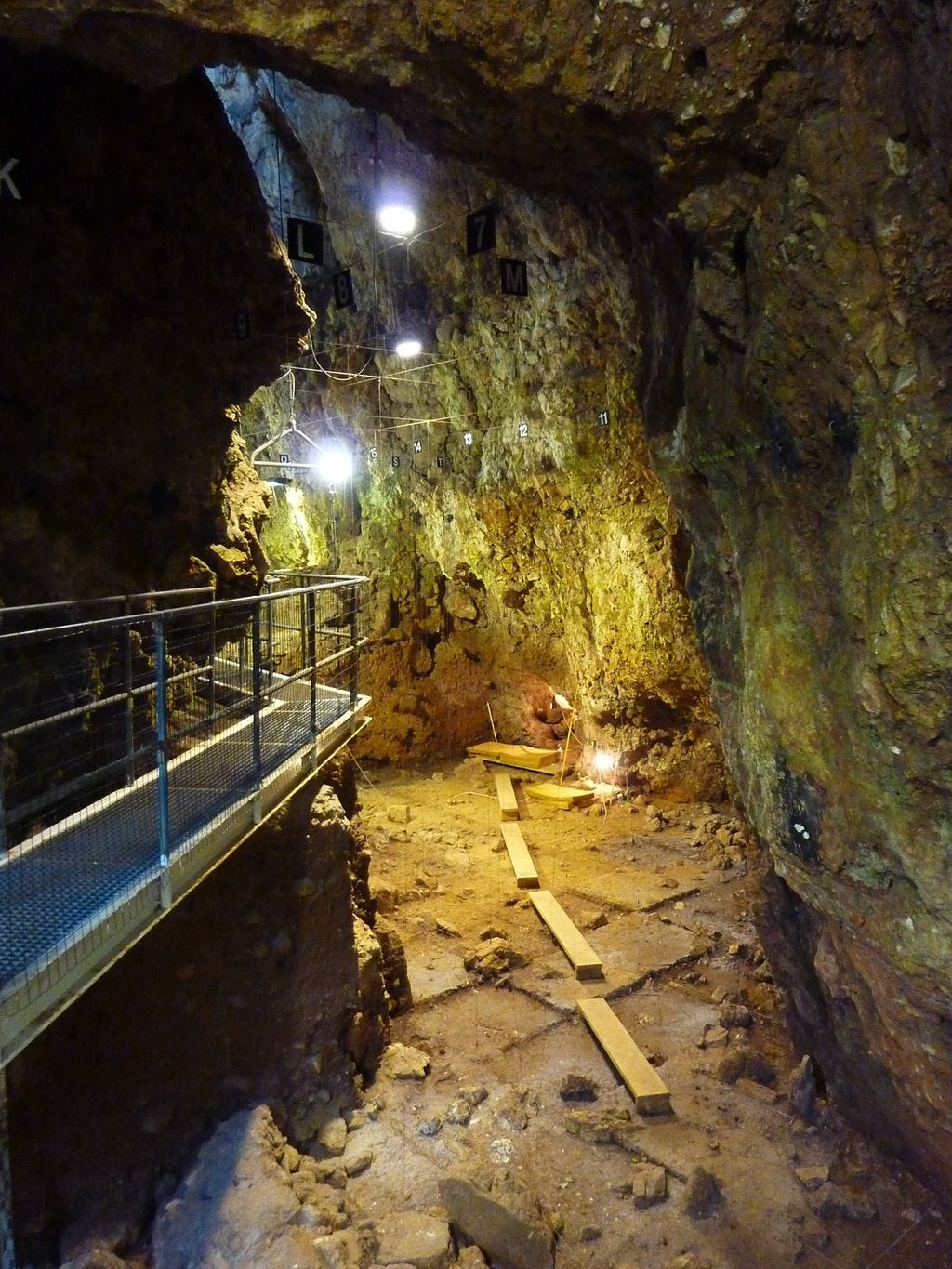
Chauvet‑Pont d’Arc (France, ~36,000 years ago): Chauvet has been so well-studied and the subject of many moving and educational books, series and movies to the extent that its chambers have been named. In the Megaloceros Gallery, it is believed that early Aurignacian culture built hearths in high-ceilinged areas, evidenced by charcoal concentrations and smoke-blackened walls. It is thought that these hearths served multiple roles from intentionally lighting the art, offering central heating, and providing light to guide movement and activities. Additionally, “ fallen blocks were moved into position to augment the natural structure” in deeper chambers implying deliberate or spatial modification.

Lazaret Cave (France, ~160,000 years ago): Excavators found hearth concentrations surrounded by stones at the cave mouth. Inside, delimitations between hearth, tool-making, sleeping, and storage were evident. Micromorphological studies suggest that seaweed may have been brought in for bedding, signifying a structured, multi-zone space .
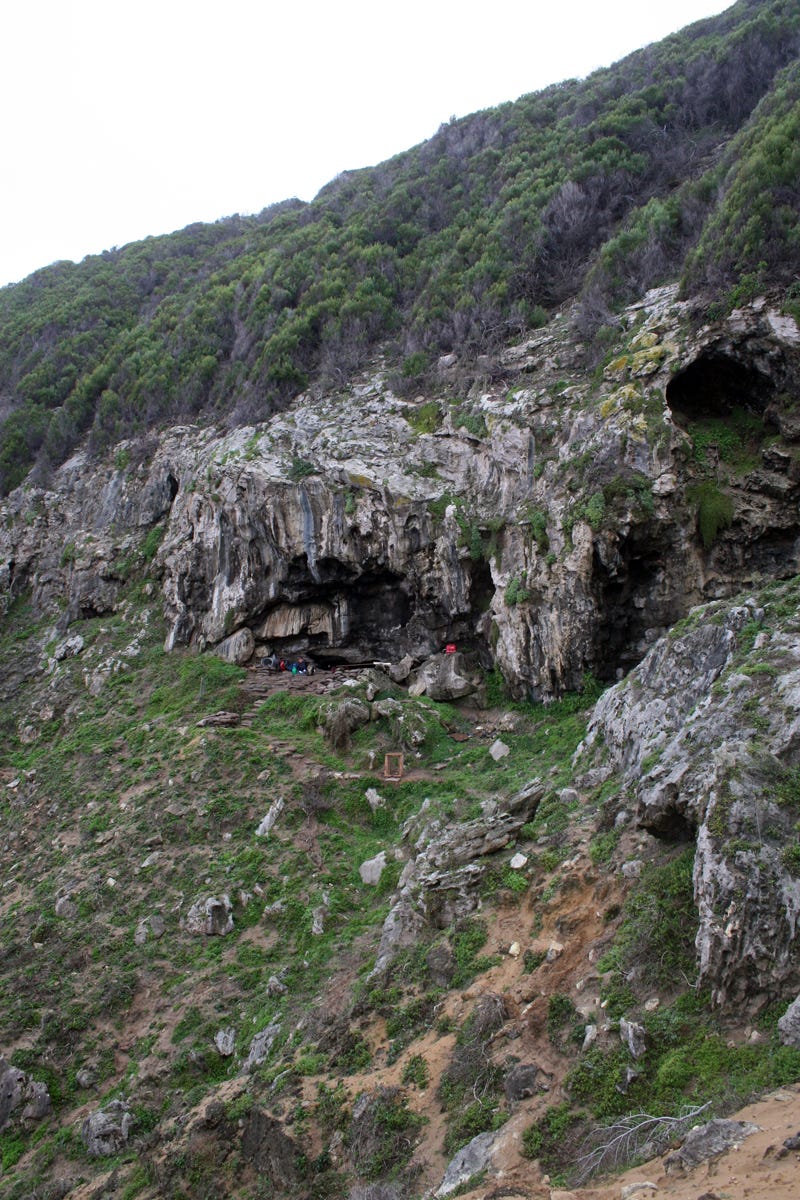
Blombos Cave (South Africa, ~75,000 years ago): Some of the most incredible discoveries about early human behavior have been made at Blombos Cave. Among these is the work completed by Henshilwood and colleagues whose excavations revealed a clear separation between areas of ochre processing, tool-making, and domestic activity. They suggest that this organized and intentional layout (workshops distinct from living spaces) demonstrates cognitive planning and spatial zoning in early modern human dwellings that is similar to the domestic zoning we use today.
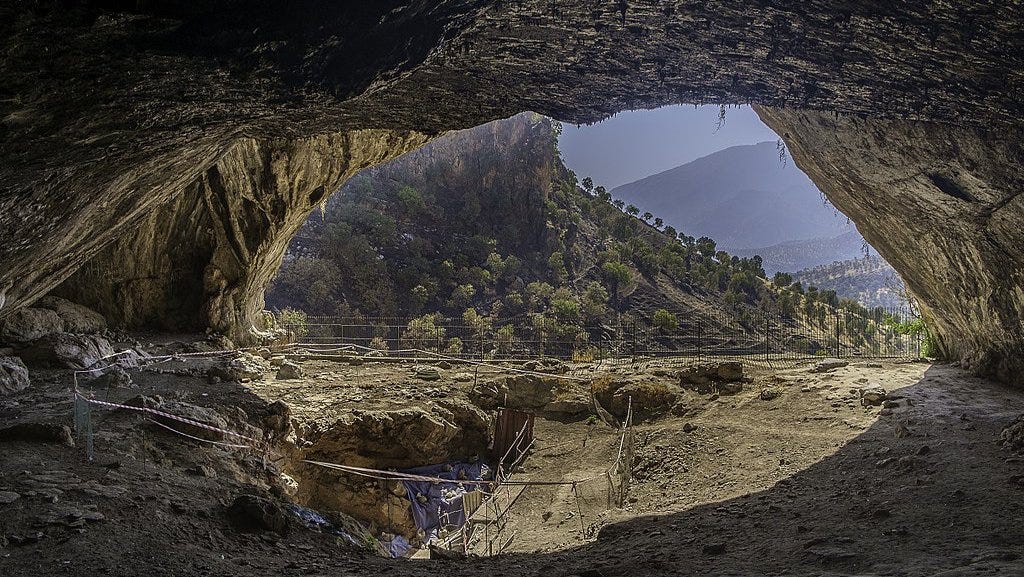
Shanidar Cave (Iraq, ~60,000–35,000 years ago): At this Neanderthal site, archaeologists excavated discrete hearths, sleeping hollows, and bone deposit clusters. Some hollows appear to have been deliberately lined or insulated, possibly with plant matter, suggesting designated sleeping spaces. Similar to Blombos, the clustering of tools and remains further points to an intentional spacial layout.
The most heartwarming and fascinating considerations here (imo) are how these sites collectively reveal that prehistoric humans (and Neanderthals) were purposefully shaping and organizing their cave environments, long before recorded architecture, just like we do today. We humans love our spaces. We love to design them effectively and meaningfully, making them functional, yet our own. For me, the delineation of space in these prehistoric cave dwellings conjures images of rearranging one’s room to get the perfect layout that aligns with both your needs and your vibes. That’s something that feels very human to me and it just might be deeply prehistoric as well.
Burning to discuss with others?⬇️