

Welcome to the Ancestral Habits newsletter☀️
Four weeks a month we explore finds related prehistoric life and culture (middle/upper Paleolithic: ~300,000-12,500 years ago)
and the evolutionary origins of all things human!
Here’s a recap of this past week on Ancestral Habits:
💘Did prehistoric humans fall in love?
🧠Did you know leaders can synchronize their brain with their followers?
🌕Do you want some cool science supporting your relationship with the moon?
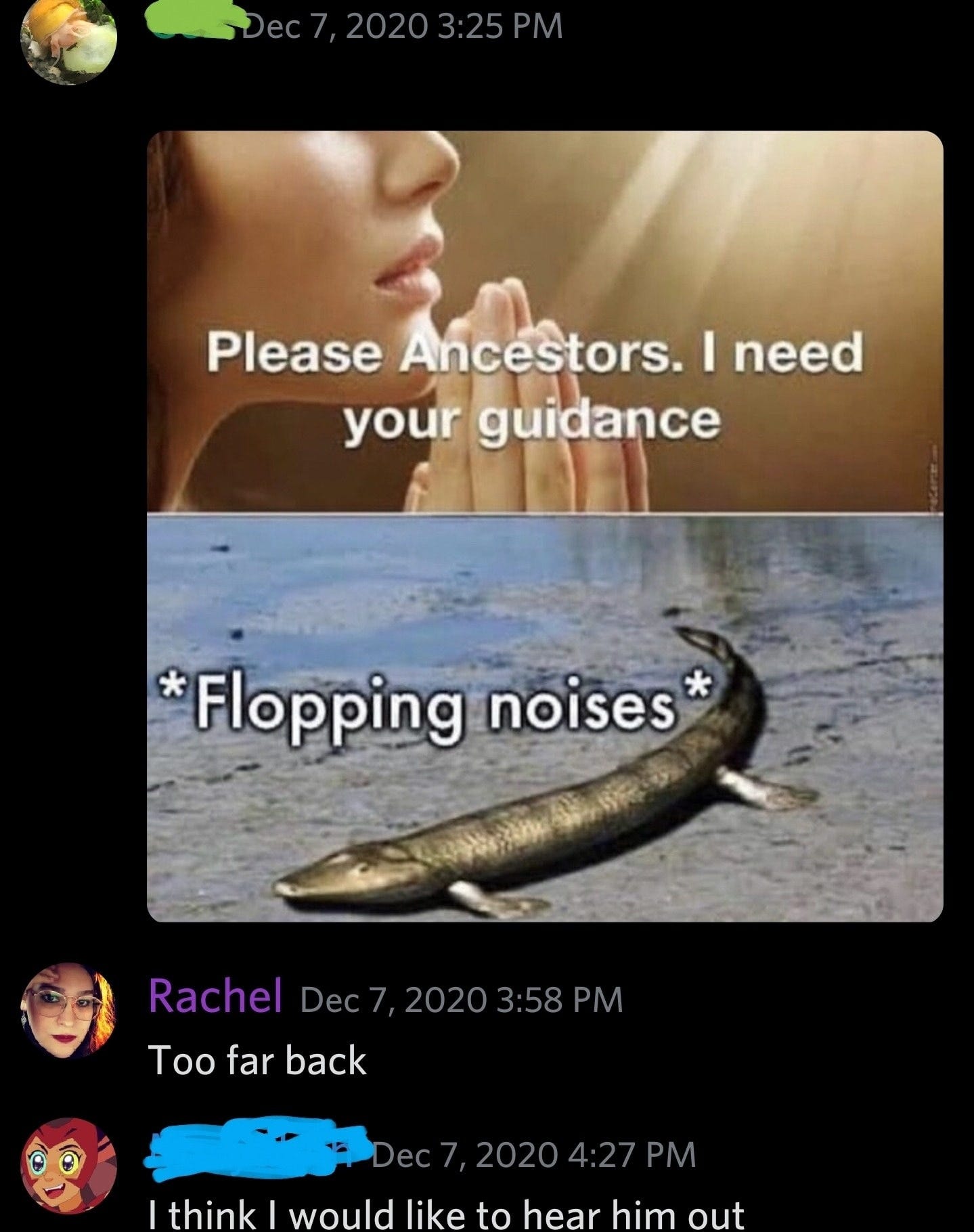
Humor is prehistoric and so are memes!
FYI:
📝Want to search my Instagram content for specific topics? I created a website just for this! https://www.ancestral-habits.com/
🤗Like what you see and want to support? Buy Me a Coffee☕️
📚Can’t get enough archeology and anthropology? Check out my friend James’ Substack. He shares recent discoveries from all of ancient human history.
🤓Hardcore nerds (paid subscribers), read on below for:
(For week 1, everyone has access!)
4 cool headlines relating to human origins
A deep dive into some deep questions:
the evolutionary origins of conspiracy theorists (🤯)
why do humans whisper?
Jump into the subscriber chat to share your thoughts!
Here are 4 cool findings related to human origins and prehistoric human life and culture:
💕A new timeline for Neanderthal interbreeding with modern humans.
“A new analysis of DNA from ancient modern humans (Homo sapiens) in Europe and Asia has determined, more precisely than ever, the time period during which Neanderthals interbred with modern humans, starting about 50,500 years ago and lasting about 7,000 years -- until Neanderthals began to disappear.”
👯♂️Twins were the norm for our ancient primate ancestors suggesting the now more prevalent singleton pregnancies had evolutionary advantages.
“Our recent research suggests that twins were actually the norm much further back in primate evolution, rather than an unusual occurrence worthy of note. Despite the fact that almost all primates today, including people, usually give birth to just one baby, our most recent common ancestor, which roamed North America about 60 million years ago, likely gave birth to twins as the standard.”
🍽Humans Were Eating Each Other 18,000 Years Ago, Bones Found In Polish Cave Suggest
”The subject of human cannibalism in past human cultures has been hotly debated. Now new research finds strong evidence that it was practiced in Europe some 18,000 years ago. This skull has not been subjected to cannibalism but is an example of human remains dating to the Magdalenian era (found in Spain).”
🌋Homo Erectus Loved Collecting Spherical Volcanic Rocks For Some Unknown Reason.
”As it happens, rounded rocks have been found at sites occupied by ancient hominids across the world, although until now researchers had only shown an interest in those that were clearly sculpted by these prehistoric humans.”

Below we’re exploring:
the evolutionary origins of conspiracy theorists (🤯)
why do humans whisper?
Belief in conspiracy theories is culturally universal. But why? (A non-conspiratorial theory)
Okay, first of all- universal!? I was sure conspiracy theories were a byproduct of ‘these unprecedented times’ but would you look at that. Apparently, not only are these theories and theorists common across modern cultures, but they may span our species’ timeline as well. This paper explores why humans are prone to believing in conspiracy theories, suggesting that these beliefs may have evolved from cognitive mechanisms that once helped us identify hidden threats, specifically through the ability to detect malevolent, intentional forces acting covertly. Conspiracy theories may emerge when this adaptive threat management system overgeneralizes the presence of perceived threats, leading individuals to become suspicious of something that isn’t actually there.
In the evolved environment, the ability to detect conspiracies may have also actually helped us avoid harmful coalitions of deceitful individuals, while today, it can lead to maladaptive behaviors in our large-scale, modern societies.
And consider this: humans have an inherent tendency to recognize patterns, even when none exist. This skill was likely crucial for survival in the evolved environment, where identifying patterns in the behavior of others, such as alliances, could signal potential danger. However, this same cognitive ability can lead us to mistakenly perceive unrelated social networks as conspiratorial groups working together with malicious intent, especially as large modern populations veer away from the small, collaborative and cooperative social networks in which we evolved.
And when fellow conspiracy theorists come together, not only can it define their social identity in what feels like a safe and like-minded community, but cognitive biases abound. One example is confirmation bias where individuals selectively seek information that confirms their preexisting beliefs, further entrenching conspiracy theories. Another example is proportionality bias, the tendency to believe that major events must have major causes, leading to the belief that significant events (like a political scandal or a global crisis) must be the result of a coordinated, deliberate conspiracy.
Distrust, particularly towards authority figures or institutions, also fuels conspiracy theories. The tendency to view powerful entities with suspicion can amplify beliefs in conspiracies, as people are more likely to interpret events as being orchestrated nefariously.
The authors of the paper ultimately suggest that the belief in conspiracy theories is essentially an evolutionary mismatch- where the potentially adaptive value of conspiracy thinking in prehistoric human environments becomes mismatched and maladaptive in modern societies. While the cognitive mechanisms that underpin conspiracy thinking may have been beneficial in helping early humans avoid threats, they can lead to harmful consequences in contemporary settings, such as the erosion of trust in institutions, the spread of misinformation, irrational beliefs and behaviors, and significant social and political implications.
van Prooijen JW, van Vugt M. Conspiracy Theories: Evolved Functions and Psychological Mechanisms. Perspect Psychol Sci. 2018 Nov;13(6):770-788. doi: 10.1177/1745691618774270. Epub 2018 Sep 19. PMID: 30231213; PMCID: PMC6238178.
Why do humans whisper?
Humans are the only species to both whisper for communication and experience psychological aphonia, a condition where someone can only whisper. Because these traits are unique to humans and do not occur in other primates, it is thought that they are rooted in our evolutionary biology. This paper hypothesizes that the human brain developed specific switching mechanisms that allow whispering to occur by modifying the normal speech production system. In whispering, the speech mechanism operates similarly to normal speech, but a switch activates the laryngeal abductor muscle, preventing the larynx from completely closing, resulting in turbulence noise.
“Whispered speech is a kind of ritualized behavior
that occurs mostly in certain limited situations”.
Okay but WHY did we evolve this ability, right?
In a 2003 paper entitled “Social and psychobiological aspects of whispered speech”, author J. Cirillo questions if “the whispering of humans could be interpreted as a ritual which has evolved analogously to dueting” (think birdcalls). Cirillo cites other animals who use duetting to form and sustain stable pair bonds, such as Gibbons and Siamangs.
Overall, he suggests that “whispering can be regarded as an ‘ingroup’-ritual which has evolved from normal speech” and perhaps developed to “enrich the repertoire of signals which mates or partners can use to communicate their private messages”.
How cute is that🥺💚
Cirillo J. Social and psychobiological aspects of whispered speech. Available from: <www.diss.fu-berlin.de/2003/302>.
Burning to discuss with others?⬇️